

You’ve been a successful mechanic for 20 years.
You’ve got all the tools. All the technical knowledge.
You’re happy. Confident. You love training up the new apprentices and graduates. Sharing the tricks of the trade. Passing on your expertise and wisdom gives you a genuine thrill.
Sure, sometimes you have to crack the whip. Jobs have to get done. Targets must be met.
Busy, busy, busy.
Okay. If you are honest, you’ll admit that sometimes the “busy, busy, busy” does drown out the training.
But that’s life, right?
Targets to meet. Profits to make. Bills to pay.
Busy business is good business.
Then one day you find yourself staring at an EV holding an oil can.
You realise that you are unprepared.
Even worse, your apprentices are doomed.
I see similar stories unfolding at every turn.
A one-eyed focus on productivity and being busy. The sacrifice is proper, valuable development.
How did so many managers and leaders lose the training and development habit?
I think I have a few thoughts.
And perhaps a way forward.
Development has become an event
Somewhere along the way, development became something formal.
A yearly review. A box in the HR system. A SMART goal.
It’s an meeting that sits uncomfortably in the calendar, usually squeezed between a budget meeting and a project update.
This is a problem. Because development is not an annual event. It is a rhythm.
It happens in the small, regular, human conversations between managers and their people.
The quick check-in after a difficult meeting.
The thoughtful question after a project slips.
The quiet encouragement before someone steps into a bigger room.
The honest feedback that arrives while it is still useful.
Not six months later, dressed up in corporate language and uploaded into a performance system.
The 1:1 has been hijacked
The one-on-one should be one of the most valuable conversations in working life.
It should be where a manager asks:
- How are you going?
- What are you learning?
- What is stretching you?
- What is frustrating you?
- Where do you want to grow?
Too often, it seems to become something else.
- A status update.
- A task review.
- A project checkpoint.
- An interrogation about some deadline.
Useful? Sometimes. Developmental? Rarely.
At some point, the 1:1 stopped being about the person and became about the quarter.
And if every conversation is about delivery, the employee slowly learns that their growth is secondary.
The work matters. The numbers matter.
The person becomes secondary to both.
The three forces working against development
I do not think most managers are careless or uncaring.
In fact, many care deeply.
They want their people to grow. They want to coach. They want to give feedback well.
But three forces keep getting in the way.
1. The first is short-termism.
Modern work is obsessed with the near horizon.
This week – This month – This quarter.
Development rarely rewards us on that convenient timetable.
The best development conversations usually produce results slowly. Confidence grows. Judgement sharpens. Trust deepens. Capability compounds.
These things matter enormously.
They are just really hard to put in a Friday dashboard.
2. The second force is measurability.
If something cannot be easily measured, it is often treated as less important.
We can measure sales calls, project milestones, response times, utilisation, revenue, cost, defects, tickets, and hours.
But how do you measure:
- A better judgement call?
- A more confident conversation?
- A stronger sense of ownership?
- A person who now speaks up before the mistake happens?
The most valuable growth is often visible long before it is measurable.
3. The third force is discomfort.
Many managers avoid development conversations because they are not quite sure what to say.
They worry that development somehow means promising a promotion.
Or mapping the next pay rise.
Or having a difficult conversation they are not prepared for.
So, they wait.
And the longer they wait, the heavier the conversation becomes.
It is like leaving that strange noise in the engine bay for six months and hoping it becomes jazz.
It never does.
Development is part of the job
Actually, I would go further. Development is the job.
Everything else is largely a by-product.
The purpose of leadership is to help people do better work, become more capable, and grow beyond what they could do alone.
Targets matter. Performance matters. Delivery matters.
Of course they do.
But they should be the result of good leadership, not a replacement for it.
A leader’s real work is building the capability, confidence, judgement, and courage of the people in their care.
And that does not happen by accident.
It happens through attention. Through conversation. Feedback. Practice. Trust.
And the occasional brave sentence.
Development is broader than promotion
One reason managers might avoid development conversations is that they think development means “next job”.
Sometimes it does. Often it does not.
Development might mean building a stronger skill stack.
- Better judgement.
- Sharper communication.
- Better stakeholder management.
- More confidence with ambiguity.
It might also mean giving someone a stretch assignment. Or inviting them into a meeting they would not normally attend. Maybe helping them practise a difficult conversation.
Encouraging them to learn something that has no obvious short-term payoff, but makes them a broader, more rounded human being.
Development is not always a ladder. Sometimes it is a lattice. Sometimes it is a wider toolkit.
Sometimes it is helping someone become more key-shaped, able to unlock more doors because they can operate in more rooms.
The habit can be rebuilt
The good news is that this is not complicated.
Hard, yes. Complicated, no.
The development habit can be rebuilt one conversation at a time.
Start with the next 1:1.
Spend less time asking for updates you could have read in an email.
Spend more time asking questions that help the person think.
Try these:
- What part of your work is stretching you most right now?
- Where do you feel underused?
- What is one skill you would like to build over the next six months?
- What conversation are you avoiding?
- What feedback would help you most?
- Where would you like more challenge?
- What support would make the biggest difference?
Then listen. Listen properly. No rushing to fix.
No turning it into a project plan too quickly.
Whatever you do, do NOT pretending the HR system is the conversation.
The system records the development. It does not create it.
A small invitation
If you are a manager or leader, perhaps this is a useful moment to ask:
When did I last have a real development conversation with each person in my team?
Not a status update. Not a performance correction. Not a quick “how are you?” while opening another spreadsheet.
A real conversation.
About their growth. Their confidence. Their future. Their skill stack. Their potential.
If the answer makes you slightly uncomfortable, good.
That is often where the habit starts again.
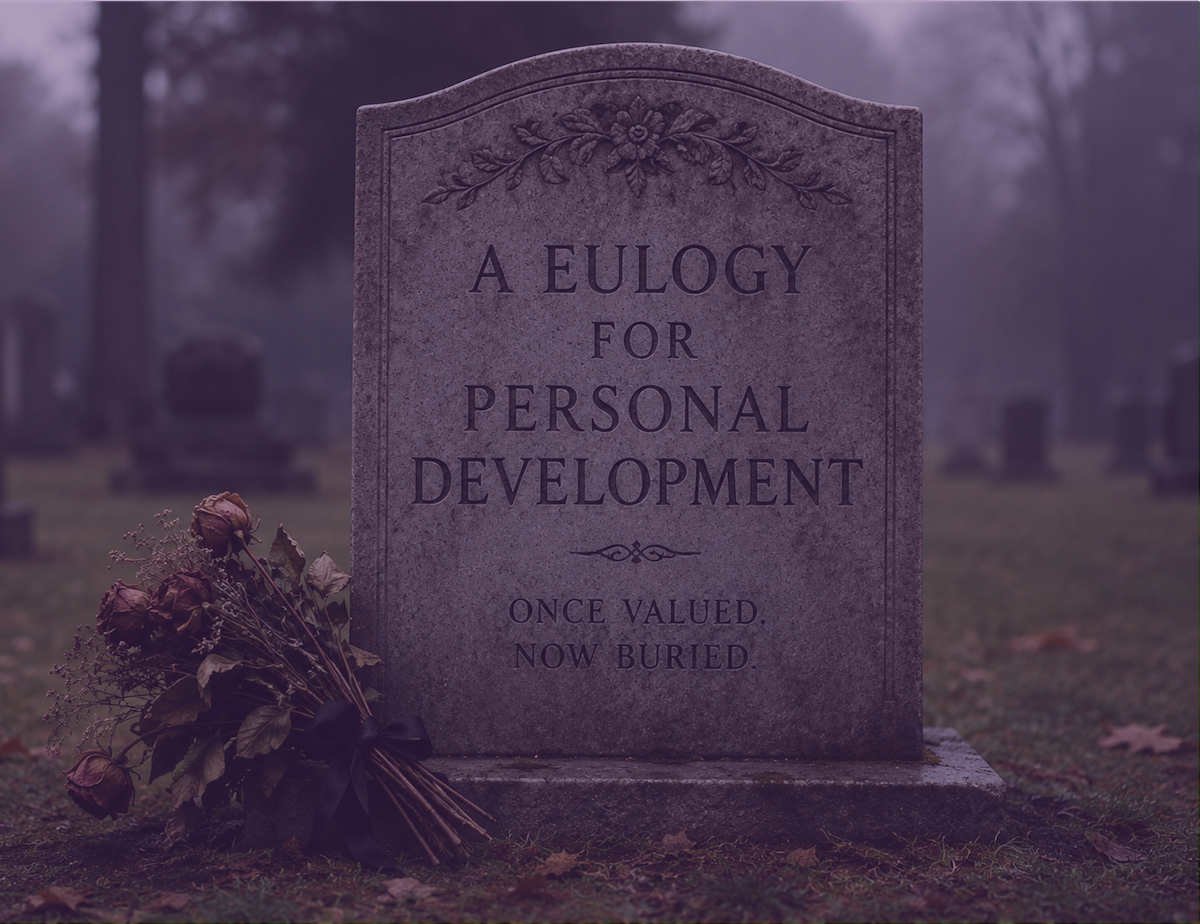
Personal development does not need a eulogy. But it may need a rescue mission.
And the best place to begin is with the next conversation.
